

The Low-Risk Illusion
A dangerous sense of relief has settled over enterprise product teams whose AI applications fell outside the high-risk categories of the EU AI Act’s Annex III. The assumption is that because an agent merely summarises documentation, routes internal support tickets, or drafts marketing copy, it sits safely outside the regulatory microscope.
This is a misreading of the European regulatory landscape. The AI Act is only half of a coordinated pincer movement.
The AI Act governs what an AI system does. The EU Cyber Resilience Act (CRA) governs how software is built, tracked, and secured. It does not care about your prompt alignment, your fairness audits, or your model’s downstream utility. It cares that your software connects to a network and emits data. Because an autonomous agent or Model Context Protocol (MCP) framework depends on direct network communication to execute its loops, it falls squarely inside the CRA’s central definition: a “product with digital elements” (PDE) (European Parliament and Council, 2024, Article 3(1)).
Worse for your project plan, the CRA’s clock runs faster. The CRA’s substantive conformity obligations apply from 11 December 2027, near-simultaneous with the AI Act’s high-risk regime for standalone Annex III systems. But the CRA’s mandatory reporting duties do not wait for that date. They bite on 11 September 2026, roughly fifteen months earlier, the day ENISA’s Single Reporting Platform goes live (European Commission, 2024; ENISA, 2026).
That alignment is recent. The AI Act originally set its standalone Annex III obligations to apply from 2 August 2026; the Digital Omnibus on AI, reached as a provisional political agreement on 7 May 2026 and still pending formal adoption at the time of writing, pushed that date to 2 December 2027. The two regimes now land within the same fortnight, nine days apart, rather than on literally the same day. Either way the central point holds: whether or not the Omnibus is formally adopted, the CRA’s reporting clock on 11 September 2026 beats the AI Act’s Annex III obligations by more than a year.
That deadline is mere months away. If you dodged the AI Act through a low-risk design classification, the CRA is about to catch you on the rebound. Classification was never the perimeter.
Loophole 1: The Death of the “As-Is” Open Source Shield
For three decades, commercial software engineering has run on an efficient shortcut: import open-source libraries, package them into an enterprise offering, and shelter the balance sheet behind the standard disclaimer, “THE SOFTWARE IS PROVIDED ‘AS IS’, WITHOUT WARRANTY OF ANY KIND.”
The CRA dissolves that shield for commercial operators.
The regulation does carve out genuine open source. A non-commercial maintainer, and the lighter “open-source software steward” category the CRA creates for foundations and stewarding bodies, is shielded from the full manufacturer obligations and from administrative fines (European Parliament and Council, 2024, Articles 3(14), 24, and 64). But that protection evaporates the moment the code earns money inside your product. If an enterprise integrates open-source agentic components, Python orchestration libraries, or upstream model frameworks into a commercial product or service, the enterprise inherits the full legal status of the manufacturer.
If those upstream dependencies carry unpatched CVEs, latent vulnerabilities, or malicious supply-chain injections, the liability lands on your balance sheet. And it is not a token penalty. Failure against the essential cybersecurity requirements in Annex I, or against the manufacturer obligations in Articles 13 and 14, sits in the CRA’s top fine tier: up to EUR 15 million or 2.5% of total worldwide annual turnover, whichever is higher (European Parliament and Council, 2024, Article 64).
You can no longer pass the security buck to an uncompensated open-source maintainer. If a framework like LangChain or CrewAI runs un-intercepted inside your runtime, you are legally warranting every line of that code to European regulators. The disclaimer protects the author. It no longer protects you.
The architectural answer to this dependency exposure is a supply-chain inventory built for AI: an AI-BOM (Software Bill of Materials for AI). The CRA already mandates a machine-readable SBOM as an essential requirement (European Parliament and Council, 2024, Annex I). To satisfy it for an agentic system, that inventory has to go further than a conventional dependency manifest: a cryptographically signed, machine-readable record of every model weight, wrapper, library, and system dependency, traced down to the underlying host layer.
Loophole 2: The 24-Hour Exploitation Clock
Traditional enterprise vulnerability management runs on an accounting cadence. A scanner flags an unpatched dependency, a review board triages it, a ticket lands in a sprint, and the fix ships inside the next 30-to-90-day window.
The CRA dismantles that cadence for actively exploited vulnerabilities.
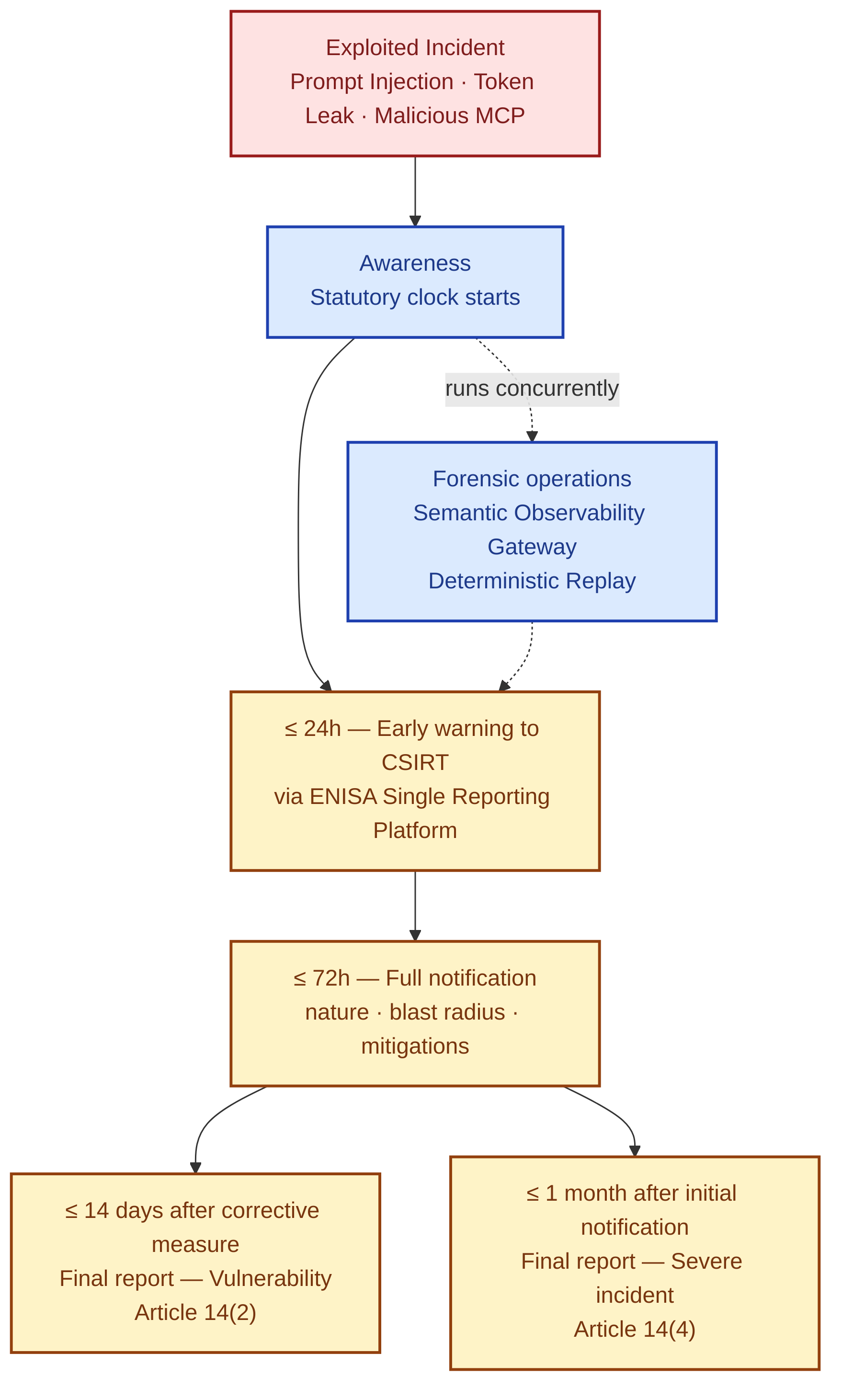
Under Article 14, the moment your team becomes aware that an attacker has successfully exploited a vulnerability inside your product, a zero-day prompt injection slipping past an edge rule, or a malicious third-party MCP server exfiltrating database tokens, two parallel reporting tracks engage (European Parliament and Council, 2024, Article 14; ENISA, 2026):
- For actively exploited vulnerabilities (Article 14(2)): an early warning notification to your national CSIRT via ENISA’s Single Reporting Platform without undue delay and in any event within 24 hours; a full vulnerability notification within 72 hours detailing the exploit, suspected blast radius, and any corrective or mitigating action; a final report within 14 days of a corrective or mitigating measure becoming available.
- For severe incidents impacting product security (Article 14(4)): an early warning notification within the same 24-hour window; a full incident notification within 72 hours; a final report within one month of the initial notification.
This redefines “compliance readiness.” It stops being a design-time paperwork exercise and becomes a runtime forensic operation measured in hours. If your SRE team needs forty-eight hours just to grep through unstructured application logs to establish whether a token leak even occurred, you have not merely suffered a breach. You have missed a statutory deadline. A late incident report is its own violation.
Satisfying that window requires Deterministic Replay (Primitive 8) and Verifiable Audit Logs (Primitive 5), two of the sixteen primitives set out in the Trustworthy Agentic AI Blueprint (Sakura Sky and Stevens, 2026). When an incident triggers, the platform must generate a high-fidelity flight recording of the event, reconstructing the precise prompt sequence, context window, and tool path, so the vulnerability can be verified, patched, and reported before the clock runs out.
 Forensic readiness is no longer an internal nicety. It is a legal mandate with a stopwatch attached.
From Static Security to Runtime Isolation
Overlay the CRA’s supply-chain mandates onto an agentic architecture and it becomes clear why running agents naked on standard cloud instances is a terminal compliance risk. Agents propose actions dynamically, from unpredictable semantic input, so you cannot pre-calculate their network destinations with a static firewall. Architecture is the dominant perimeter that keeps pace with a probabilistic workload.
To meet the CRA’s requirement for secure-by-default operation across the product lifecycle, the runtime has to harden into a zero-trust perimeter on two axes.
Workload isolation via TEEs. The agent execution layer, including local orchestration scripts and transient vector-memory state, runs inside a hardware-backed Trusted Execution Environment such as Intel TDX or AMD SEV-SNP. Even if a dependency exploit compromises the agent, data-in-use stays encrypted in RAM and isolated from host-level tampering or confidentiality attacks.
eBPF host containment. Network endpoints are restricted dynamically. Every tool destination, model API route, and external vector database has to match an Infrastructure-as-Code allow-list, enforced at the kernel with eBPF. If an imported open-source library tries to dial an unrecognised IP, the packet is dropped on the host before it leaves the box.
This is the design philosophy behind the Governed Agent Trust Environment (GATE) framework. By funnelling execution through deterministic primitives, compliance stops being a frantic development sprint and becomes a static by-product of your infrastructure configuration. Compliance you have to assemble is compliance you have already failed.
Where Sentinel Fits
Building a machine-readable AI-BOM pipeline and a 24-hour forensic evidence loop from scratch is an immense platform-engineering lift, and most teams do not have the months to spare before September 2026. This is exactly where our security framework, Sentinel, fits.
Sentinel bridges the development cycle and the CRA’s operational requirements. It runs continuous static analysis on model dependencies and code libraries to generate standard-compliant SBOMs at build time. At runtime, it handles the cryptographic signing of the evidence chain, tracking payload hashes across your gateways and funnelling telemetry into a format built for rapid forensic response. When the reporting clock triggers, Sentinel keeps your SRE team out of the log files. It hands them the precise replay traces needed to isolate the vulnerability and meet the obligation inside the window. A crash is not an exploit, and a log is not evidence. Sentinel produces the proof.
The Sakura Position
The CRA has erased the boundary between application code and regulatory liability. For engineering and infrastructure leaders staring at the September 2026 deadline, the execution priority reduces to three decisions.
- Audit the upstream AI supply chain. Treat every imported agent library, open-source framework, and model wrapper as a direct liability on the balance sheet. If you cannot produce a cryptographically signed bill of materials for its dependencies, it does not cross your production boundary.
- Architect for immediate forensic readiness. Stop treating audit logs as a checklist item for internal IT. Treat the evidence pipeline as an active system component. If you cannot reconstruct an agent’s reasoning path within minutes of an anomaly, your architecture is non-compliant by design.
- Decouple the perimeter. Do not let third-party code packages dictate your system security. Wrap probabilistic workloads in a deterministic shell of eBPF egress containment and policy-enforced tool gateways.
Autonomy without architecture is a warranty you never meant to sign. The work is in the wiring.
If your engineering teams are navigating the September 2026 CRA deadline, or you need to re-architect your application supply chains to support rapid incident reporting, let’s connect. The strategic roadmap is mapped in The Executive’s AI Playbook, and the technical specifications are set out in our Trustworthy Agentic AI Blueprint. Get in touch.
Disclosure: Sakura Sky implements the Governed Agent Trust Environment (GATE) in client engagements. GATE is an open framework, published under CC BY 4.0 at deterministicagents.ai, and is vendor-neutral. The framework was authored by Andrew Stevens; readers should weight the GATE references in this article accordingly. The Trustworthy Agentic AI Blueprint cited here is likewise Sakura Sky and Stevens work, and the same weighting applies.
Not legal advice. This article provides general commentary on the EU Cyber Resilience Act (CRA) for an engineering audience. It is not legal advice and is not a substitute for advice from qualified counsel. Readers should obtain independent legal advice on how the CRA and its related provisions apply to their specific products, deployments, and jurisdictions.
References
ENISA, 2026. Single Reporting Platform (SRP). Athens: European Union Agency for Cybersecurity. Available at: https://www.enisa.europa.eu/topics/product-security-and-certification/single-reporting-platform-srp [Accessed 6 June 2026].
European Commission, 2024. Cyber Resilience Act - Reporting obligations. Brussels: Directorate-General for Communications Networks, Content and Technology. Available at: https://digital-strategy.ec.europa.eu/en/policies/cra-reporting [Accessed 6 June 2026].
European Parliament and Council, 2024. Regulation (EU) 2024/2847 of the European Parliament and of the Council of 23 October 2024 on horizontal cybersecurity requirements for products with digital elements and amending Regulations (EU) No 168/2013 and (EU) 2019/1020 and Directive (EU) 2020/1828 (Cyber Resilience Act). Official Journal of the European Union, L 2024/2847, 20 November. Available at: https://eur-lex.europa.eu/eli/reg/2024/2847/oj [Accessed 6 June 2026].
Sakura Sky and Stevens, A., 2026. The Trustworthy Agentic AI Blueprint: 16 Missing Primitives for Enterprise Autonomy, Version 1.0.4. Available at: https://whitepaper.download/trustworthyagenticai/ [Accessed 6 June 2026].
Stevens, A., 2026. GATE - Governed Agent Trust Environment, Version 1.2.8 framework paper. Deterministic Agents. Available at: https://deterministicagents.ai [Accessed 6 June 2026].