

Secure Memory Governance (Part 14)
Agent systems are moving beyond stateless “prompt in, answer out” interactions into long-lived reasoning (ok, probabilistic) systems with:
- ephemeral scratchpads
- session-level working memory
- multi-step workflow state
- shared embedding spaces
- multi-tenant long-term memory
- user-specific preference profiles
- cross-workflow knowledge stores
- vector memories that shape planning
Most organizations treat this memory layer as an implementation detail - a vector DB, a key-value store, or a cached JSON blob. In reality, memory is a security boundary.
It contains the most sensitive state in an agent system, outlives individual workflows, and silently influences future behavior. A compromised or poorly governed memory layer leads to:
- data leakage
- unbounded retention
- poisoning and contamination
- schema drift
- cross-tenant exposure
- nondeterministic behavior
- model drift or “haunted” agents
This post defines the primitives required to make agent memory trustworthy.
Memory Layers (Concept Diagram)

Primitive 1: Memory Layer Classification
A mature system must explicitly classify its memory. Each layer has different durability, sensitivity, and governance needs.
Ephemeral Reasoning Memory
- Short-lived agent scratchpads: intermediate reasoning, tool outputs, draft plans.
- Should never persist beyond the execution window.
Session Memory
- State across steps of a single workflow (retrieved docs, partial results).
- Automatically deleted at workflow completion.
Long-Term Task Memory
Stores non-PII, multi-session operational state. Examples:
- workflow checkpoints
- project-level context
- execution preferences
- recurring task state
This is about operational continuity, not long-term knowledge. Sensitive cross-team or cross-user knowledge belongs in Shared or Personal layers.
Shared Knowledge Stores
High-risk, high-impact stores: shared embeddings, common corpora. One poisoning event here affects the entire system.
Personalized User Memory
User-specific preferences, histories, private data. Requires strict tenancy boundaries, deletion workflows, and access control.
Global System Memory
Fact tables, ranking signals, policy hints, learned aggregates. Corruption here changes everything.
Primitive 2: Access Control, Isolation, and Tenancy Boundaries
Memory must be treated as a secure API. Every read/write must be authorized according to:
- agent identity
- agent version
- tenant
- workflow context
- trust domain (region/security boundary)
- memory layer
The memory system should enforce:
- per-layer RBAC
- per-tenant isolation
- region-scoped access
- per-agent capability restrictions
- strict scoping of retrieval operations
This eliminates:
- cross-tenant leakage
- accidental contamination
- covert memory exfiltration
- agents accessing memory they should never see
Primitive 3: Schema Governance and Versioned Memory Contracts
As agents evolve, their memory structure must evolve too. Without governance, schema drift leads to silent corruption.
Memory schemas must be:
- explicitly defined (Pydantic/Protobuf)
- versioned
- compatible across versions (or migrated)
- validated on every write
- validated on every read
Example: Versioned Pydantic Schemas
from pydantic import BaseModel, Field
from typing import List, Optional

class UserMemoryV1(BaseModel):
    version: int = 1
    interests: List[str]
    last_search: Optional[str] = None

class UserMemoryV2(BaseModel):
    version: int = 2
    interests: List[str]
    search_history: List[str] = Field(default_factory=list)
    embedding_vector: List[float]  # dimensionality MUST match embedding model version
Primitive 4: Memory Retention, Expiry, and Compliance
Memory must not accumulate indefinitely. Every layer needs explicit retention and deletion policies.
A trustworthy system enforces:
- Per-layer TTL/expiry - Automatic cleanup for session and short-lived memory.
- Per-tenant retention requirements - Some customers demand strict retention windows.
- Right-to-be-forgotten workflows - Targeted deletion of personal or sensitive data.
- Cryptographic deletion - When data is stored in append-only or immutable systems (e.g., verifiable logs or shared immutable corpora), deletion is impossible. Revoking the encryption key becomes the strongest form of data erasure rendering the memory unreadable forever.
- Legal holds - Prevent automated deletion when required.
- Audit logs - Every deletion must be recorded and verifiable.
Memory Governance Pipeline Diagram

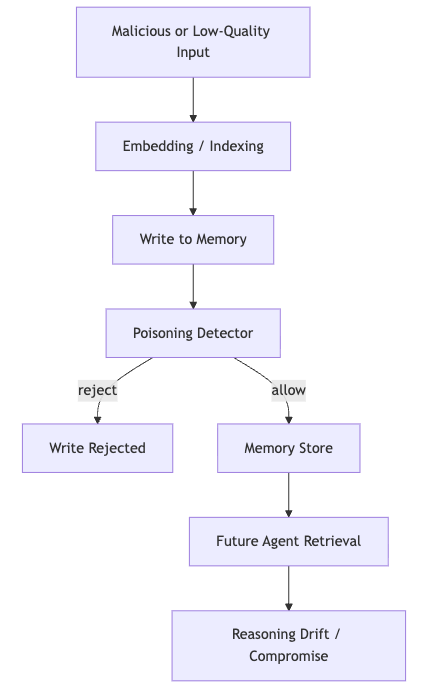
Primitive 5: Memory Poisoning Detection and Sanitization
Memory poisoning is the long-term version of prompt injection - an attacker inserts adversarial content into memory so future agents retrieve and trust it.
Mitigation must occur at:
- insertion (sanitization, provenance, classification)
- retrieval (reranking, anomaly detection)
- lineage (strong audit trails)
Example: Sanitization with Safe Error Handling
class MemorySanitizationRejected(Exception):
"""Raised when memory content fails sanitation checks."""
pass

def sanitize_memory_entry(text: str) -> str:
clean = text.encode("ascii", "ignore").decode()
if len(clean.strip()) == 0:
raise MemorySanitizationRejected(
"Memory write rejected: Failed content policy check."
)
return clean
Avoid revealing why content failed - doing so is an information leak.
Poisoning Flow & Defense Diagram
Primitive 6: Compartmentalization and Memory Sandboxing
Memory must be segmented, not monolithic.
Sandboxing isolates memory by:
- tenant
- agent
- workflow
- region
- risk tier
- memory layer
This prevents:
- low-trust agents writing to high-trust stores
- contamination of global memory
- cross-customer leaks
- experimental workflows affecting production behavior
Sandboxing can be:
- logical (namespaces, partitions)
- physical (separate clusters)
- contextual (ephemeral workflow memory)
Primitive 7: Memory Governance in the Orchestrator
The orchestrator (Part 13) is the only component with enough context to enforce memory governance globally.
It knows:
- the agent identity and version
- workflow context
- tenant boundaries
- resource budgets
- policy constraints
- risk tier
- region and trust domain
It can therefore:
- authorize memory reads/writes
- validate schemas
- enforce retention
- apply poisoning checks
- enforce quotas
- log lineage (Part 5)
- integrate with replay (Part 8)
- ensure memory events meet formal invariants (Part 9)
This makes memory a governed subsystem, not a side effect of agent behavior.
Why This Matters
As soon as agents store state, memory becomes the long-tail risk of the system. Poorly governed memory leads to silent failures - the kind that do not appear immediately but manifest weeks later as drift, bias, leakage, or inexplicable agent behavior.
Secure memory governance transforms memory from a vague, unstructured blob into a well-defined, auditable, compliant subsystem. It makes retention explicit, access controlled, schemas governed, poisoning mitigated, and cross-tenant boundaries enforceable.
And crucially, memory provenance - the record of who wrote what, when, and under which policy - is the essential input for Workflow Lineage, the core focus of Part 15: Agent-Native Observability. Without trustworthy provenance, lineage graphs and reasoning traces are incomplete or misleading.
Practical Next Steps
- Inventory and classify all memory locations: Identify scratchpads, caches, vector DBs, key-value stores, logs, and profile data.
- Define access rules per layer: Who can read/write? Which workflows? Which tenants?
- Version your memory schemas Use Pydantic or Protobuf. Include explicit version fields.
- Implement retention and deletion: Start with TTL for session memory. Add cryptographic deletion.
- Sanitize and validate all writes: Enforce content policy checks. Attach provenance.
- Route memory access through a gateway: Never let agents talk to memory backends directly.
- Plan response playbooks for poisoning events: Tie them into replay and audit logs for forensic analysis.
Secure memory is the substrate on which safe agents operate.
Part 15 will build on this by introducing Agent-Native Observability: reasoning traces, workflow lineage, divergence metrics, and provenance graphs - all dependent on the governed memory layer defined here.