

If you buy cloud services in the EU, you have probably heard that cloud exit fees end on 12 January 2027. For the one-off move of a service’s data to another provider, that is broadly right. The traffic that crosses between providers while you run both, and the traffic to your own users, are governed by other rules, and on a long migration they can be the larger part of the bill.
The short version for a finance lead: from 12 January, a provider cannot charge you for switching a service to another provider or on-premises, although minimum-term penalties in your contract still apply and some custom-built services are excluded. Until then it can charge only its own direct costs of the switch. Data sent between providers while you use both can still be charged at cost after January, with no end date. What you pay to serve your own users does not change.
Some of what follows depends on your own contract and circumstances, and the post points out where. It is general commentary, not legal advice.
Article references are to the Data Act, Regulation (EU) 2023/2854 (European Parliament and Council, 2023), unless stated otherwise. “Provider” means a provider of data processing services, the Regulation’s term for cloud and similar services, and “you” means the customer.
What happens on 12 January 2027
Article 29 is titled “Gradual withdrawal of switching charges”. Its first three paragraphs set out the dates:
From 12 January 2027, providers of data processing services shall not impose any switching charges on the customer for the switching process.
From 11 January 2024 to 12 January 2027, providers of data processing services may impose reduced switching charges on the customer for the switching process.
The reduced switching charges referred to in paragraph 2 shall not exceed the costs incurred by the provider of data processing services that are directly linked to the switching process concerned. (European Parliament and Council, 2023, Art. 29)
Until 12 January 2027, then, a provider may charge for switching, but only its own costs directly linked to the switch, and from that date it may not charge at all. The Commission’s FAQ describes it the same way, saying providers “must reduce any switching charges (including egress charges) from 11 January 2024 onwards” and may no longer charge for switching, data egress included, from 12 January 2027 (European Commission, 2026, Q54).
Article 29 names 11 January 2024 as the start of the cost cap, but the Regulation has generally applied only since 12 September 2025, and Article 50 gives the switching chapter no earlier date (Art. 50). The FAQ repeats the 2024 date without addressing Article 50. In my reading the cap clearly applies to any switch since September 2025; if you were charged above cost for a switch between January 2024 and September 2025, that is a question for a lawyer.
Article 29 also requires information. Before you sign, the provider must give you clear information on its standard service fees, its early termination penalties, and the reduced switching charges it may impose, and where relevant it must tell you about services that would be highly complex or costly to switch (Art. 29(4) and (5)). Where applicable, that information has to be made public in a dedicated section of its website or in another easily accessible way (Art. 29(6)). Your contract must also contain a clause on the switching charges allowed under Article 29 (Art. 25(2)(i)).
What counts as a switching charge
The ban applies to “switching charges”, and the definition is narrow:
(36) ‘switching charges’ means charges, other than standard service fees or early termination penalties, imposed by a provider of data processing services on a customer for the actions mandated by this Regulation for switching to the system of a different provider or to on-premises ICT infrastructure, including data egress charges; (European Parliament and Council, 2023, Art. 2(36))
Standard service fees are excluded, and the recitals say they remain payable until the contract ends (European Parliament and Council, 2023, recital 89). Early termination penalties are excluded too: the same recital confirms that fixed-term contracts may include “proportionate early termination penalties”, in line with Union or national law. If your contract has a minimum term, January does not remove what you owe for leaving early. Because the definition covers only “the actions mandated by this Regulation”, extra help you ask the provider for, beyond its switching obligations, can also be charged if you agree the price in advance (recital 89).
The charge also has to be for switching, which the Regulation defines as the process by which the customer “changes from using one data processing service to using another data processing service of the same service type, or other service, offered by a different provider of data processing services, or to an on-premises ICT infrastructure” (Art. 2(34)).
Data egress charges have their own definition: “data transfer fees charged to customers for extracting their data through the network from the ICT infrastructure of a provider of data processing services to the system of a different provider or to on-premises ICT infrastructure” (Art. 2(35)). Traffic from your application to your own users and customers is neither switching nor in-parallel use. It stays part of what you pay for the service, at whatever rate your contract sets.
Running two providers at once
Many migrations do not move everything in one go. You stand up the new platform, move some of the traffic, and run the two side by side for a while, with data flowing between them. Plenty of companies also run two providers permanently, for example an application on AWS with analytics in BigQuery. The Regulation deals with both under a separate article.
Article 34, in Chapter VIII on interoperability, covers “in-parallel use of data processing services”. Its second paragraph deals with charges:
- Where a data processing service is being used in parallel with another data processing service, the providers of data processing services may impose data egress charges, but only for the purpose of passing on egress costs incurred, without exceeding such costs. (European Parliament and Council, 2023, Art. 34(2))
There is no end date in that paragraph, and the recitals make clear there is not meant to be one. Recital 99 explains that in-parallel use “relates to situations in which customers do not terminate a contract to switch to a different provider”, that egress for in-parallel use “can be an ongoing activity, in contrast with the one-off egress required as part of the switching process”, and that providers “should therefore continue to be able to impose data egress charges, not exceeding the costs incurred, for the purposes of in-parallel use after three years from the date of entry into force of this Regulation” (European Parliament and Council, 2023, recital 99). The Commission’s FAQ says the same: in-parallel egress can still be billed at cost “even after 12 January 2027” (European Commission, 2026, Q54). If you are in financial services, note that the same recital says multi-cloud can contribute to digital operational resilience, citing Regulation (EU) 2022/2554, the Digital Operational Resilience Act. A permanent setup like the AWS and BigQuery example above is the kind of use recital 99 describes.
Article 34(1) also carries some of the switching protections across to parallel use, including the duty to remove obstacles under Article 23 and the open interface requirements in Article 30(2) to (5) (Art. 34(1)). Article 29 is not on that list, which is why the charge rules differ.
Switching is defined service by service. If you move a whole service to another provider or on-premises, that is switching, even if your wider agreement with the provider carries on for other services. If you keep using a service and add another provider’s service alongside it, recital 99 describes that as in-parallel use. The hard case is a partial move, where you take some of a service’s workloads elsewhere and keep the rest. The Regulation does not settle it, and the providers’ programmes that exclude partial moves are commercial terms, not a reading of the law. Long migrations raise a related question: Article 25(5) lets you extend the transitional period once, for a period you choose (Art. 25(5)), but how far that stretches before the move looks like in-parallel use has not been tested. Take partial moves and long transitions to counsel before you plan the transfer, because the answer decides whether the traffic is free from January or charged at cost indefinitely.
Some services are partly or wholly outside the switching rules. Where “the majority of main features has been custom-built to accommodate the specific needs of an individual customer”, or all components have been developed for an individual customer, and the service is not offered at broad commercial scale from the provider’s catalogue, Article 29 does not apply, along with Article 23(d) and Article 30(1) and (3) (Art. 31(1)). Non-production versions provided “for testing and evaluation purposes and for a limited period of time” are outside the whole switching chapter (Art. 31(2)). The provider has to tell you before you sign which obligations do not apply (Art. 31(3)), so if you have a bespoke platform, ask.
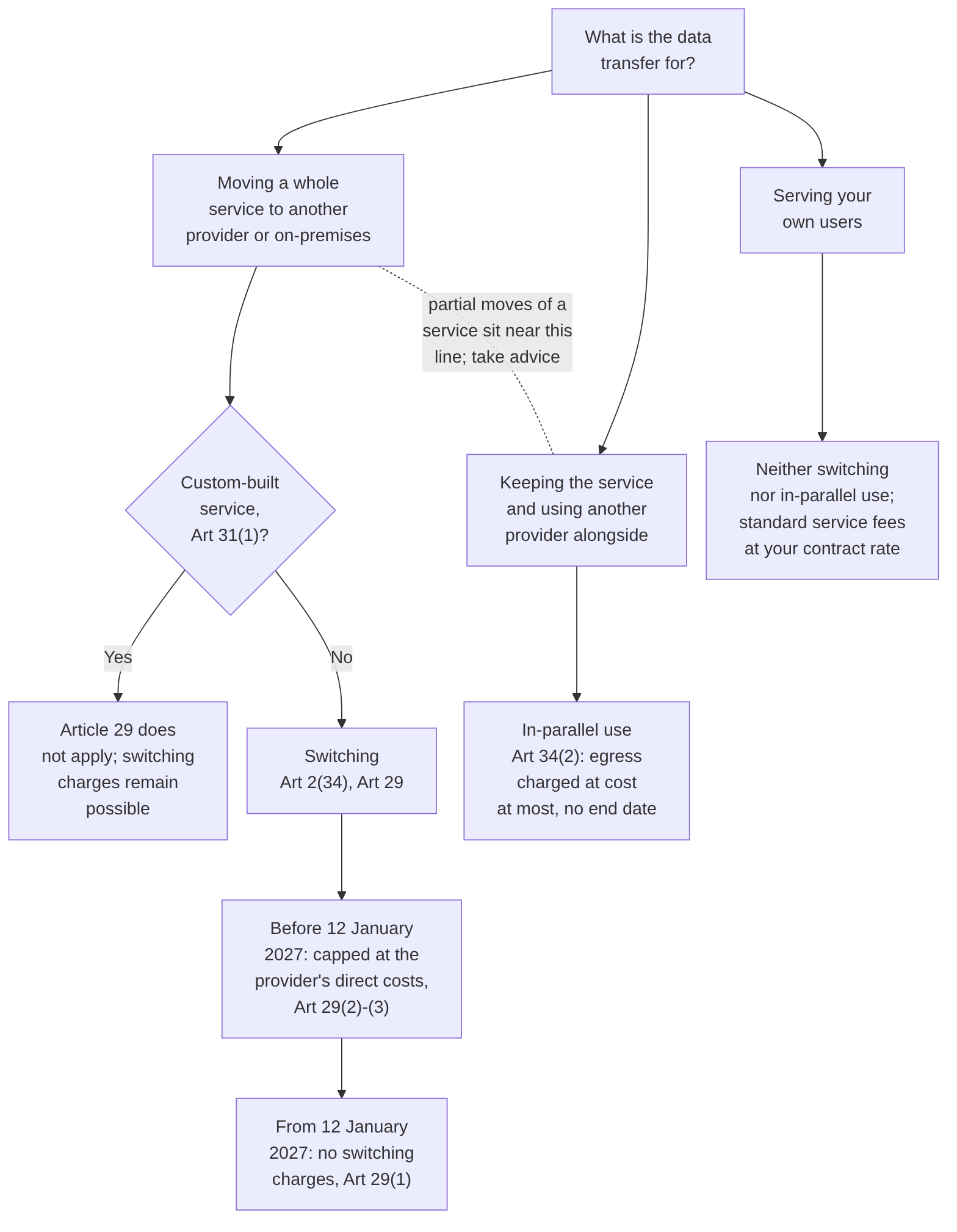
A worked example
The numbers below are made up for illustration. Suppose you are moving 40 TiB of data off a provider, running both platforms in parallel for a while with 8 TiB a month crossing between them, and serving 25 TiB a month to your own users. Suppose your contract rate for egress is 85 per TiB and the provider’s actual cost is 8 per TiB, in whatever currency your contract uses. That cost figure is an assumption; the provider is the only one who knows the real one.
| Transfer | Rule | Before 12 January 2027 | From 12 January 2027 |
|---|---|---|---|
| Moving the 40 TiB dataset off the provider | Switching, Art. 29 | At most cost: 320 | No charge |
| Cross-provider traffic while both run, 8 TiB a month | In-parallel use, Art. 34(2) | At most cost: 64 a month, against 680 at the contract rate | Same: at most 64 a month |
| Traffic to your own users, 25 TiB a month | Standard service fees | 2,125 a month at the contract rate | Unchanged |
Table 1. Illustrative transfer costs under the Data Act, using assumed volumes and rates.
On these assumptions, January saves you at most 320, once, and possibly nothing if you already qualify for your provider’s free exit programme. If your provider bills parallel traffic at the contract rate today, holding it to cost would save up to 616 a month. Your user-facing egress is untouched by either. The result depends heavily on the inputs, above all the gap between the provider’s cost and its rate, and that gap is the least certain number here. A very large one-off move with a short parallel run makes the switch charge matter more, and a long parallel run makes the Article 34(2) cap matter more. “Costs incurred” is not defined in the Regulation, so ask the provider to state its figure in writing.
How the providers’ exit programmes work
AWS, Google Cloud, and Microsoft Azure all announced free data transfer out for customers leaving in early 2024: Google Cloud on 11 January (Zavery, 2024), AWS on 5 March (Stormacq, 2024), and Microsoft on 13 March (Microsoft, 2024). AWS said its waiver “follows the direction set by the European Data Act” (Stormacq, 2024), and Microsoft said its exemption “aligns with the European Data Act” (Microsoft, 2024).
| AWS | Google Cloud | Microsoft Azure | |
|---|---|---|---|
| What has to move | All data from all eligible accounts, or all data off a particular service (Amazon Web Services, n.d.a) | All of a given service, ending the agreement for it; partial moves excluded (Google Cloud, 2025) | The account, with all subscriptions cancelled; single services for customers with a UK billing address transferring from UK datacentres (Microsoft, 2026a) |
| How you claim | Request to support at least two months before the switch; credits, which can be charged back if the transfer was for another purpose (Amazon Web Services, n.d.a) | Credit on the final invoice; Google may review the movement of data (Google Cloud, 2025) | Request to support; credit after review (Microsoft, 2026a) |
| Time allowed | 180 days for customers outside the EU; EU customers follow the EU Data Act Addendum (Stormacq, 2024; Amazon Web Services, n.d.b) | 14-day intake, 30 days to begin, a migration period of at least 30 days, completion notice within 180 days of it ending (Google Cloud, 2025) | 60 days, or longer if you give a migration timeline in the request; 180 days for UK-billed customers transferring from UK datacentres (Microsoft, 2026a) |
| Paths not covered | Including CloudFront, Direct Connect, the Snow Family, and Global Accelerator (Amazon Web Services, n.d.a) | No excluded services named; transfers over the internet only, for products on Google’s data portability list (Google Cloud, 2025) | Including ExpressRoute, ExpressRoute Direct, VPN, Front Door, and Azure CDN (Microsoft, 2026a) |
Table 2. The three providers’ free data transfer programmes for customers leaving, as published on 28 October 2026.
For EU customers, AWS now points to a separate document. Its blog post was updated on 8 October 2026 to send EU customers “exercising a switch under the EU Data Act” to its EU Data Act Addendum (Stormacq, 2024). The addendum follows the Regulation’s process closely: a switching request at least two months ahead, a 30-day transitional period that can be extended up to seven months if AWS finds the switch technically unfeasible, and a right for you to extend once (Amazon Web Services, n.d.b).
The switching process itself still applies after January. Article 25 expects you to give notice of up to two months, followed by a transitional period of up to 30 days and a retrieval period of at least 30 days (Art. 25(2)(a), (d), and (g)), so with the maximum notice period, a 30-day transition, and the minimum retrieval period, it is about four months from notice to the end of retrieval, and longer if the transition is extended. What changes on 12 January is that the provider can no longer charge you for the switch. In my reading, the ban covers switching charges whichever network path the data takes, although port or connection fees for a dedicated link may be argued to be standard service fees. The programmes’ path exclusions will still matter for transfers that are not a switch.
For parallel use, two of the three publish an at-cost or free route. Microsoft offers at-cost transfer over the internet (and, for UK-billed customers transferring from UK datacentres, over its own premium network) for organisations with a billing address in the EEA, EFTA, or the United Kingdom, excluding customers who store their data outside those areas, using another provider “in parallel, in an interoperable manner”, refunded after validation (Microsoft, 2026b). Google’s Data Transfer Essentials covers “data transfer between services of the same organization that are distributed across different cloud service providers”, excludes applications serving end users on other providers, and is “initially offered at no charge” with advance notice if that changes (Google Cloud, n.d.). Google’s EU contract terms also restate Article 34(2) almost word for word, limiting any charge for parallel data export to “passing on the egress costs incurred by Google, without exceeding such costs” (Google Cloud, 2026). AWS’s EU Data Act Addendum deals with the switching process and has no parallel-use rates (Amazon Web Services, n.d.b), unlike its UK addendum, so for EU parallel traffic on AWS, raise the Article 34(2) cost cap with your account team.
What your contract should contain
The switching chapter has applied since 12 September 2025, so contracts for in-scope services are expected to carry a set of terms. Article 25(2) lists the minimum. In summary, and in the order the article sets them out:
- a transitional period of at most 30 calendar days, starting after the notice period, during which the provider gives “reasonable assistance” with the switch, keeps providing the service with due care, maintains a high level of security, and tells you about known risks to continuity (Art. 25(2)(a));
- an obligation on the provider “to support the customer’s exit strategy relevant to the contracted services, including by providing all relevant information” (Art. 25(2)(b));
- a clause that the contract ends when the switch completes, or at the end of the notice period if you are leaving without switching and want your data erased (Art. 25(2)(c));
- a notice period for starting the switch that “shall not exceed two months” (Art. 25(2)(d));
- an “exhaustive specification of all categories of data and digital assets that can be ported”, covering at least all exportable data (Art. 25(2)(e)), and an exhaustive list of any categories of data specific to the provider’s internal functioning that are held back because of a risk to its trade secrets, which must not “impede or delay the switching process” (Art. 25(2)(f));
- at least 30 calendar days after the transitional period to retrieve your data (Art. 25(2)(g));
- full erasure of the exportable data and digital assets “generated directly by the customer, or relating to the customer directly” after the retrieval period, provided the switch completed (Art. 25(2)(h));
- the switching charges the provider may impose under Article 29 (Art. 25(2)(i)).
If a provider says 30 days is not technically feasible, it has to tell you within 14 working days, explain why, and propose an alternative period that “shall not exceed seven months” (Art. 25(4)). Separately, you can extend the transitional period once, for a period you consider appropriate (Art. 25(5)).
On the technical side, Article 30(1) covers infrastructure providers: those offering “scalable and elastic computing resources limited to infrastructural elements such as servers, networks and the virtual resources necessary for operating the infrastructure”, without access to the software and applications running on them. They must take “all reasonable measures in their power” to help you reach functional equivalence on a destination service of the same type, and support the switch with “capabilities, adequate information, documentation, technical support and, where appropriate, the necessary tools” (Art. 30(1)). Other providers must make open interfaces available “free of charge” (Art. 30(2)). Where no relevant common specifications have been published in the central Union standards repository, providers must on request export all exportable data “in a structured, commonly used and machine-readable format” (Art. 30(5)). None of this requires a provider to build new technology, hand over protected intellectual property or trade secrets, or compromise security (Art. 30(6)).
The Commission has also published voluntary standard contractual clauses for cloud contracts, three of which turn the switching chapter into ready-to-use terms, although its site still presents them as a draft Recommendation (European Commission, 2025). If you are renegotiating, they are a useful comparison.
The Commission’s Digital Omnibus package of 19 November 2025 would exempt some adapted standard services, and SME and small mid-cap providers of non-infrastructure services, from parts of the switching regime (Sidley Austin, 2025; Greenberg Traurig, 2026). As reported in July 2026, the Council’s compromise text applies those exemptions to contracts concluded on or before 12 September 2025, keeps Article 29(1) to (3) applying to them, and was still under negotiation (Greenberg Traurig, 2026). If your provider is small or your service is heavily customised, keep an eye on it.
Where UK buyers stand
The Data Act applies to providers “irrespective of their place of establishment” when they provide services to “customers in the Union” (Art. 1(3)(f)). The Regulation does not spell out how a customer’s location is decided, but a UK customer contracting through a UK entity is unlikely to get these rights from the Act. In the UK, the pressure on egress fees has come from the Competition and Markets Authority.
The CMA’s cloud market investigation concluded in July 2025 that competition “is not working well” and named egress fees as “a key commercial barrier” to switching and multi-cloud (Competition and Markets Authority, 2025). It recommended that the CMA Board “prioritise commencing SMS investigations” into AWS and Microsoft, meaning investigations into whether they have strategic market status (Competition and Markets Authority, 2025). In March 2026 the CMA announced that the two had “set out actions on cloud egress fees and interoperability” for UK customers, “following engagement with the CMA and subject to ongoing review” (Competition and Markets Authority, 2026a). The CMA describes the arrangement as a “voluntary dialogue” (Competition and Markets Authority, 2026b).
The CMA’s October 2026 update reports that AWS and Microsoft have put free switching for UK customers into their contracts, extended their free switching windows to 180 days, and introduced reduced egress for multi-cloud, while noting that “the uptake of these schemes has been limited so far” (Competition and Markets Authority, 2026b). AWS’s UK addendum gives UK accounts a 180-day transitional period, free data transfer credits for the switch, and “reduced rates not exceeding AWS’s costs” for traffic to another provider used alongside AWS (Amazon Web Services, n.d.c). Microsoft’s at-cost parallel transfer covers UK billing addresses (Microsoft, 2026b), and Google’s Data Transfer Essentials was launched for customers in the EU and the UK (Manfra, 2025). The CMA Board plans to review whether this voluntary route is working in spring 2027 (Competition and Markets Authority, 2026b).
So on AWS and Microsoft, a UK buyer ends up with terms that look much like the EU position. The difference is that they rest on contracts and the CMA’s oversight, which its Board will review in spring 2027. If your company has entities in both the EU and the UK, check which entity holds each cloud contract, because that decides which set of terms you can rely on.
What to do before January
Check your current contracts against the Article 25(2) list. If a contract is silent on the transitional period, the categories of portable data, or the retrieval window, raise it at renewal.
Before you talk to the provider, estimate how much data each part of the move involves: the switch itself, parallel running, and normal operations. Each has different rules, and on a long migration the parallel traffic is often the line most worth negotiating.
Ask for the provider’s Article 34(2) cost basis in writing: what its egress costs are, how it calculates them, and where that is documented. If it has an at-cost or free parallel-use programme, find out how to enrol before the traffic starts, since some apply only to future usage.
If you are switching before 12 January, use the provider’s programme and check its conditions against your plan, especially the requirement to move everything off a service or account, and any excluded network paths.
Ask which switching obligations the provider says do not apply to your services, and why. Article 31(3) requires it to tell you before you contract.
If a switch will straddle 12 January, ask the provider in writing how it will bill transfers made before and after that date.
Disclosure: Sakura Sky is an UpCloud reseller, so it has a commercial interest in customers being able to move between cloud providers. UpCloud did not fund this article and did not review or approve it. Sakura Sky also provides managed cloud and GRC services.
This article is general commentary on the EU Data Act and related UK developments as at 28 October 2026. It is not legal advice. Several points are open, including how the 2024 and 2025 dates interact, how partial moves are treated, and what counts as a provider’s cost for in-parallel egress. Whether a particular transfer is switching or in-parallel use, and which terms apply to your contracts, depends on your facts, so take advice from a qualified lawyer before relying on it.
References
Amazon Web Services, n.d.a. Amazon EC2 FAQs: AWS Free Data Transfer Out Program for Switching Customers. Available at: https://aws.amazon.com/ec2/faqs/ [Accessed 28 October 2026].
Amazon Web Services, n.d.b. AWS EU Data Act Addendum. Available at: https://d1.awsstatic.com/onedam/marketing-channels/website/aws/en_US/legal/approved/eu-data-act-addendum.pdf [Accessed 28 October 2026].
Amazon Web Services, n.d.c. AWS UK Customer Switching and Portability Addendum. Available at: https://d1.awsstatic.com/onedam/marketing-channels/website/aws/en_US/legal/approved/aws-uk-customer-switching-addendum.pdf [Accessed 28 October 2026].
Competition and Markets Authority, 2025. Cloud services market investigation: summary of final decision. 31 July. Available at: https://assets.publishing.service.gov.uk/media/688b20e6ff8c05468cb7b120/summary_of_final_decision.pdf [Accessed 28 October 2026].
Competition and Markets Authority, 2026a. CMA announces package of actions on business software and cloud services. Press release, 31 March. Available at: https://www.gov.uk/government/news/cma-announces-package-of-actions-on-business-software-and-cloud-services [Accessed 28 October 2026].
Competition and Markets Authority, 2026b. Update on Cloud actions: Covering March-October 2026. 16 October. Available at: https://assets.publishing.service.gov.uk/media/6ad1cb60e5db84746b4796d1/Update_on_cloud_actions_-_covering_March_to_October_2026.pdf [Accessed 28 October 2026].
European Commission, 2025. Draft Recommendation on non-binding model contractual terms on data access and use and non-binding standard contractual clauses for cloud computing contracts. 19 November. Available at: https://digital-strategy.ec.europa.eu/en/library/draft-recommendation-non-binding-model-contractual-terms-data-access-and-use-and-non-binding [Accessed 28 October 2026].
European Commission, 2026. Frequently Asked Questions: Data Act. Version 1.4, 22 January. Available at: https://digital-strategy.ec.europa.eu/en/library/commission-publishes-frequently-asked-questions-about-data-act [Accessed 28 October 2026].
European Parliament and Council, 2023. Regulation (EU) 2023/2854 of the European Parliament and of the Council of 13 December 2023 on harmonised rules on fair access to and use of data and amending Regulation (EU) 2017/2394 and Directive (EU) 2020/1828 (Data Act). Official Journal of the European Union, L series, 22 December. Available at: https://eur-lex.europa.eu/legal-content/EN/TXT/HTML/?uri=CELEX:32023R2854 [Accessed 28 October 2026].
Google Cloud, n.d. Data Transfer Essentials overview. Available at: https://docs.cloud.google.com/data-transfer-essentials/docs/overview [Accessed 28 October 2026].
Google Cloud, 2025. Applying for free data transfer when exiting Google Cloud. Last updated 11 September 2025. Available at: https://cloud.google.com/exit-cloud [Accessed 28 October 2026].
Google Cloud, 2026. Service Specific Terms (General Service Terms, Section 16: EU Data Act Terms). Last modified 27 October 2026. Available at: https://cloud.google.com/terms/service-terms [Accessed 28 October 2026].
Greenberg Traurig, 2026. EU Digital Omnibus Package Proposes Amendments to Data Act. 15 July. Available at: https://www.gtlaw.com/en/insights/2026/7/eu-digital-omnibus-package-proposes-amendments-to-data-act [Accessed 28 October 2026].
Manfra, J., 2025. Introducing no-cost, multicloud Data Transfer Essentials for EU and U.K. customers. Google Cloud Blog, 10 September. Available at: https://cloud.google.com/blog/products/networking/new-for-the-uk-and-eu-no-cost-multicloud-data-transfer-essentials [Accessed 28 October 2026].
Microsoft, 2024. Now available: Free data transfer out to internet when leaving Azure. Azure Updates, 13 March. Available at: https://azure.microsoft.com/en-us/updates?id=now-available-free-data-transfer-out-to-internet-when-leaving-azure [Accessed 28 October 2026].
Microsoft, 2026a. Cancel and delete your Azure subscription. Microsoft Learn. Available at: https://learn.microsoft.com/en-us/azure/cost-management-billing/manage/cancel-azure-subscription [Accessed 28 October 2026].
Microsoft, 2026b. Azure data transfer fees. Microsoft Learn. Available at: https://learn.microsoft.com/en-us/azure/cost-management-billing/manage/data-transfer-fees [Accessed 28 October 2026].
Sidley Austin, 2025. EU Digital Omnibus: The European Commission Proposes Important Changes to the EU’s Digital Rulebook. Data Matters, 9 December. Available at: https://datamatters.sidley.com/2025/12/09/eu-digital-omnibus-the-european-commission-proposes-important-changes-to-the-eus-digital-rulebook/ [Accessed 28 October 2026].
Stormacq, S., 2024. Free data transfer out to internet when moving out of AWS. AWS News Blog, 5 March, updated 8 October 2026. Available at: https://aws.amazon.com/blogs/aws/free-data-transfer-out-to-internet-when-moving-out-of-aws/ [Accessed 28 October 2026].
Zavery, A., 2024. Cloud switching just got easier: Removing data transfer fees when moving off Google Cloud. Google Cloud Blog, 11 January. Available at: https://cloud.google.com/blog/products/networking/eliminating-data-transfer-fees-when-migrating-off-google-cloud [Accessed 28 October 2026].